Be True to Your School
Steel forms the backbone of the new West Niagara Secondary School
Story: Ian VanDuzer
Photography: Sandra Mulder
Construction cranes are not an unfamiliar sight in Ontario’s Niagara region. The area, best known for its world-class wineries and Niagara Falls, is rapidly undergoing a population boom powered by proximity to major urban centres and the USA-border. Since 2020, the region’s population has grown by more than 15% (accounting for 75,000 people), represented by expanding city borders, moving trucks, and new houses.
Alongside new neighbourhoods and suburbs come other needed supports: new retail plazas, new grocery stores, and, yes, new schools. The District of Niagara School Board quickly saw a need to expand their former slate of high schools and, in 2022, amalgamated three together into the brand-new West Niagara Secondary School in Beamsville, ON.
Opting to design a new school — rather than expand or renovate either of the existing schools — meant more than just expanding capacity: it meant the opportunity to design a new space to learn with intentionality. It was an opportunity too great to pass up.
Designing Education
Sam Spagnuolo and Peter Pastor — both Principals at CS&P Architects — both worked on West Niagara Secondary School. They share a comfort and ease around each other that comes from long years working together. “You go first,” Pastor nudges his co-architect.
Spagnuolo grins. “As a firm, CS&P has been around for over 60 years,” he says. “And most of our work is in education. So this is in our wheelhouse. This is what our bread and butter is.”
As Spagnuolo says, CS&P is no stranger to designing high schools. “We’ve designed hundreds,” Spagnuolo notes before adding that schools aren’t all that they do. It may be more accurate to say that CS&P works best designing multi-use spaces, of which schools are an inarguable example. Gone are the days — if they ever existed — where schools existed as a series of rooms with blackboards, desks, and chairs. Schools today — especially when they are essentially replacing three former schools — demand much, much more.
The School
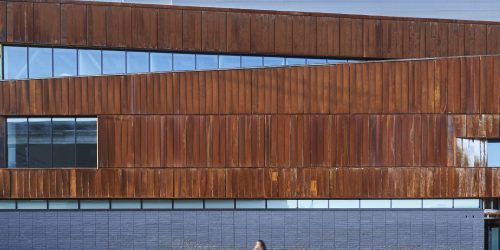
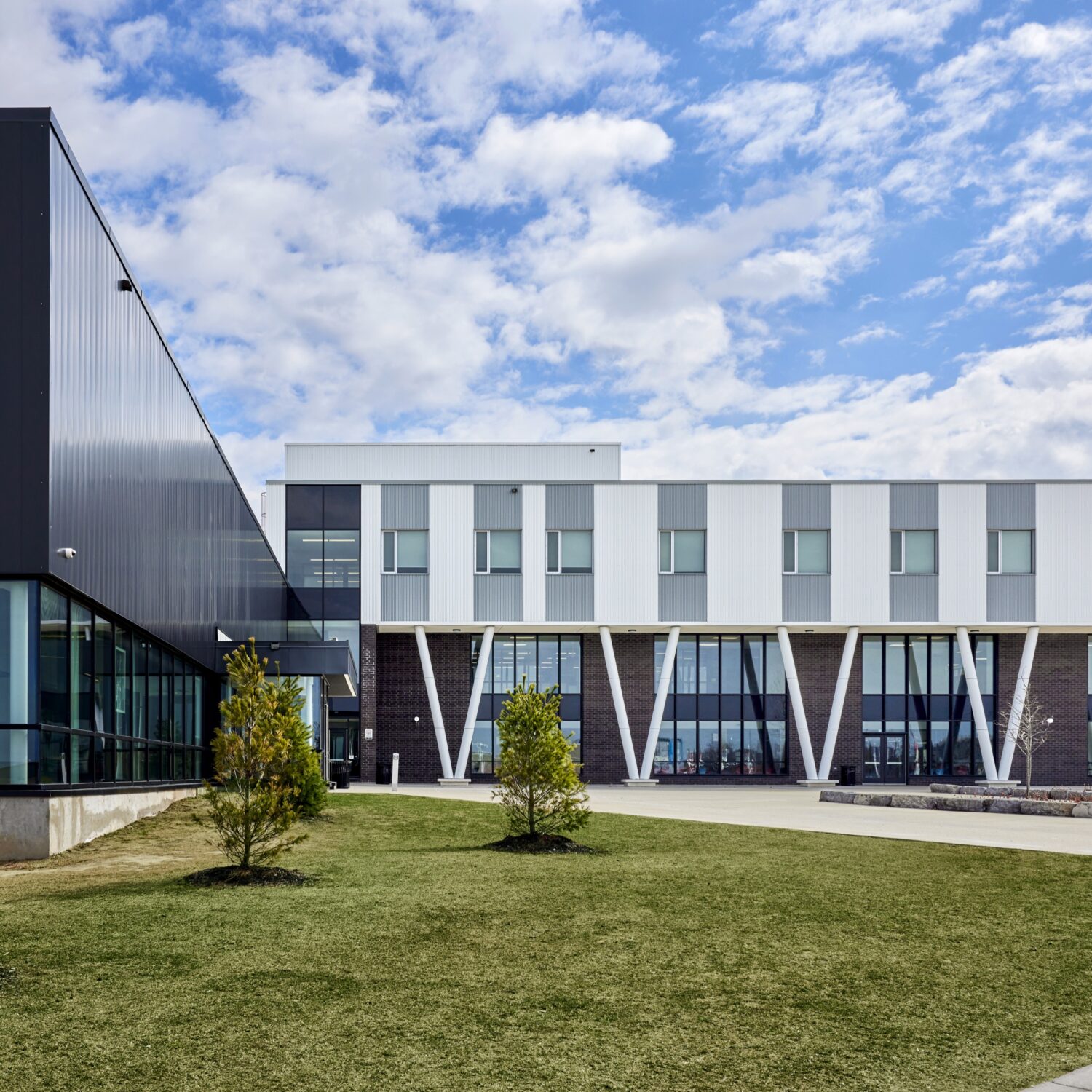
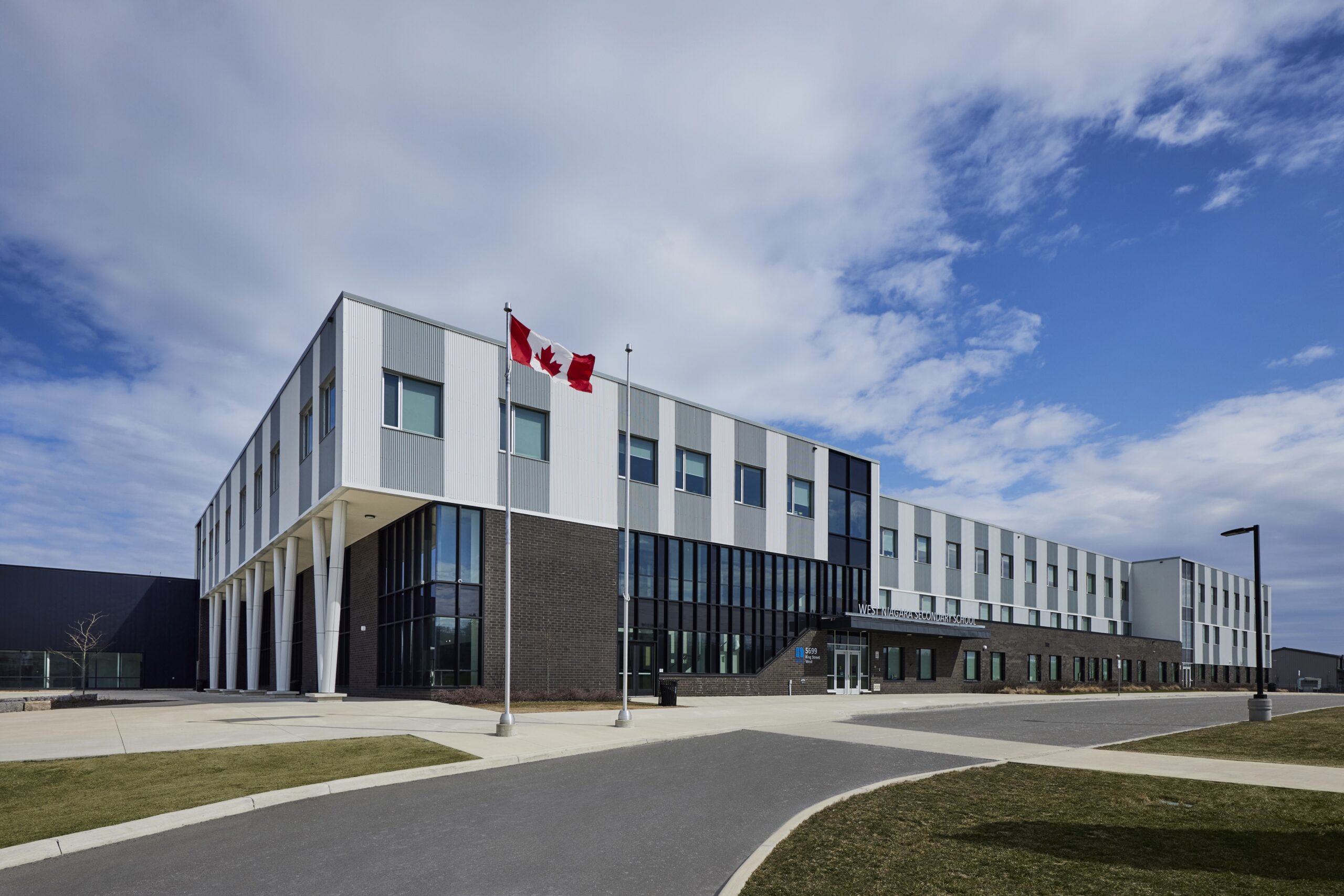
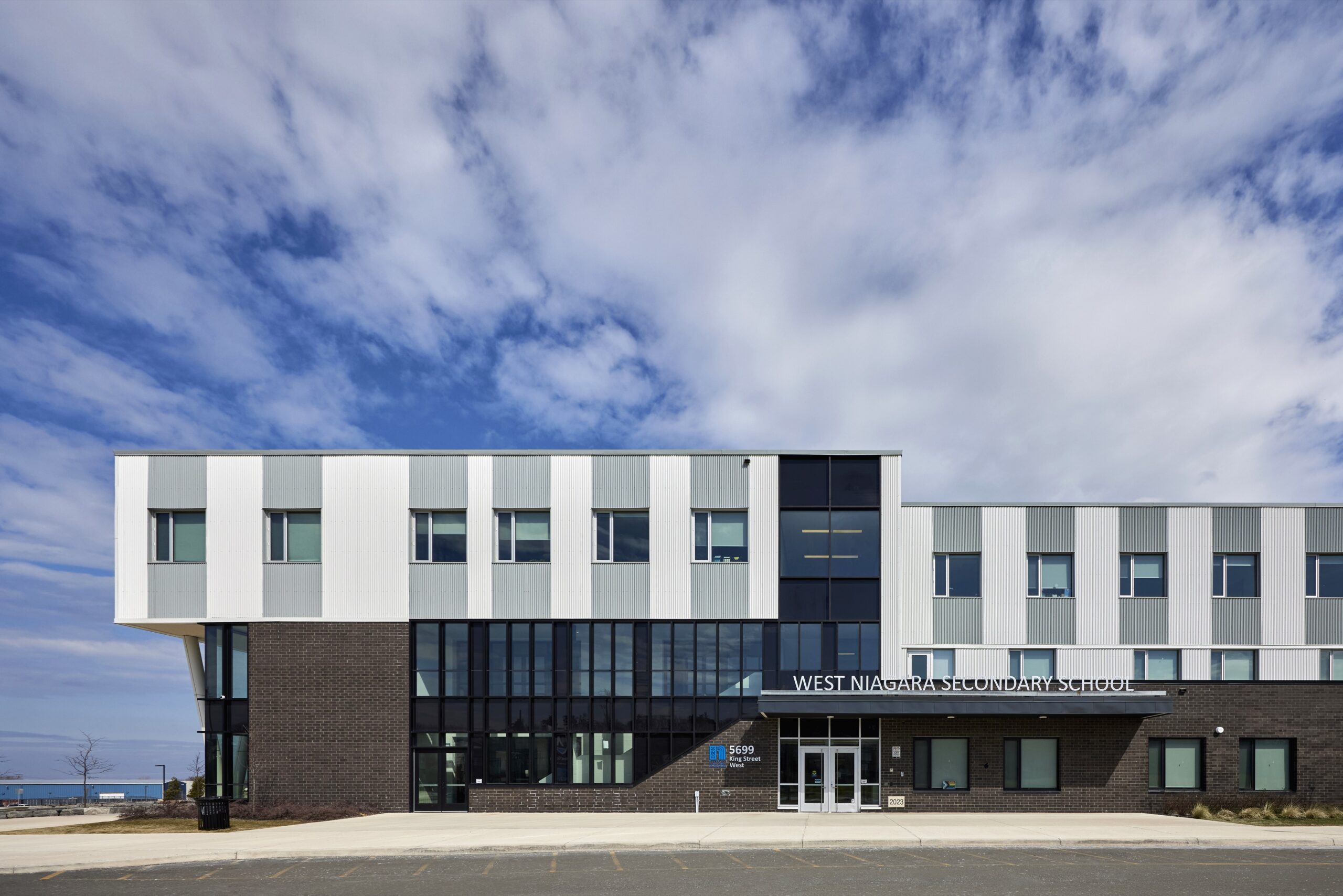
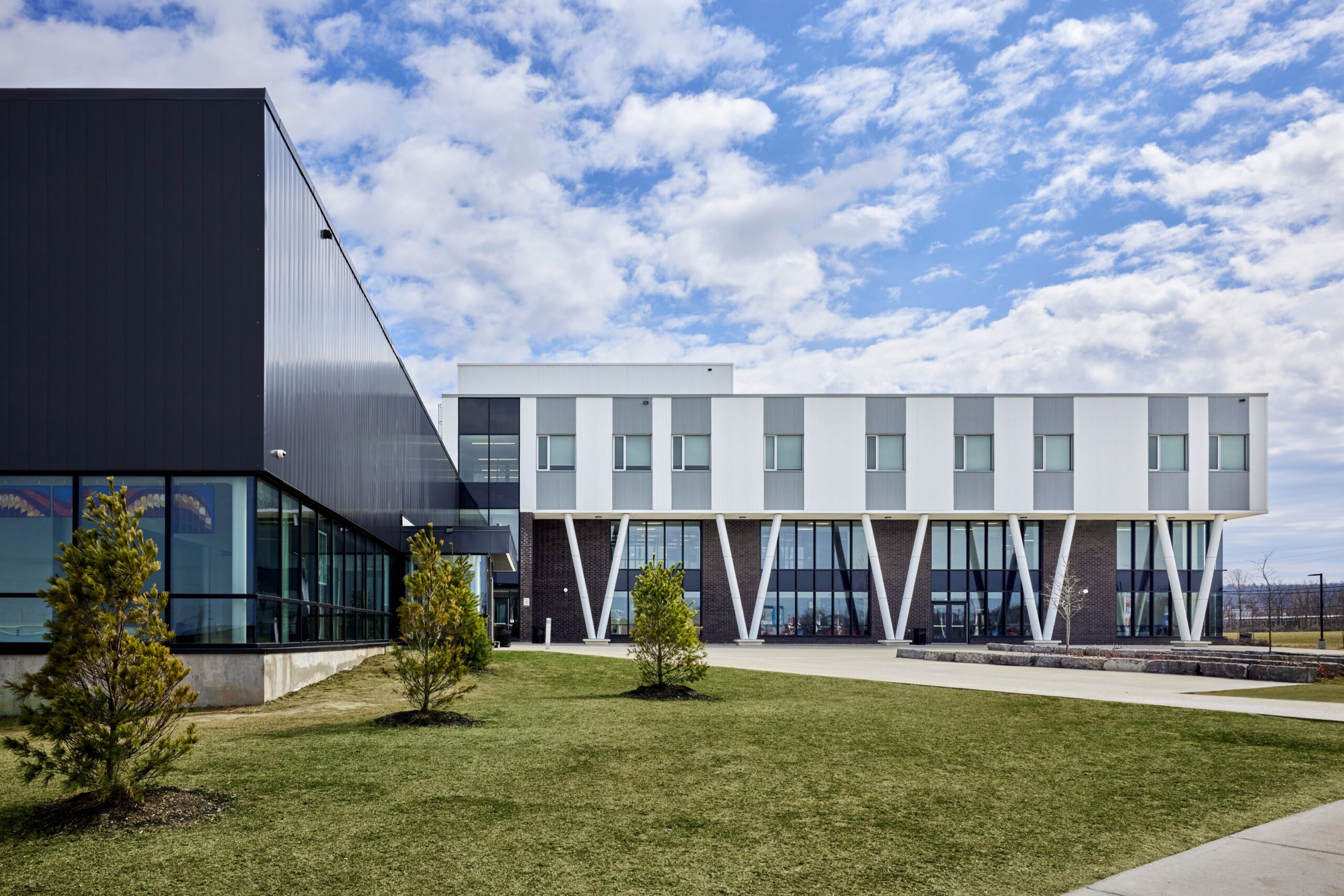
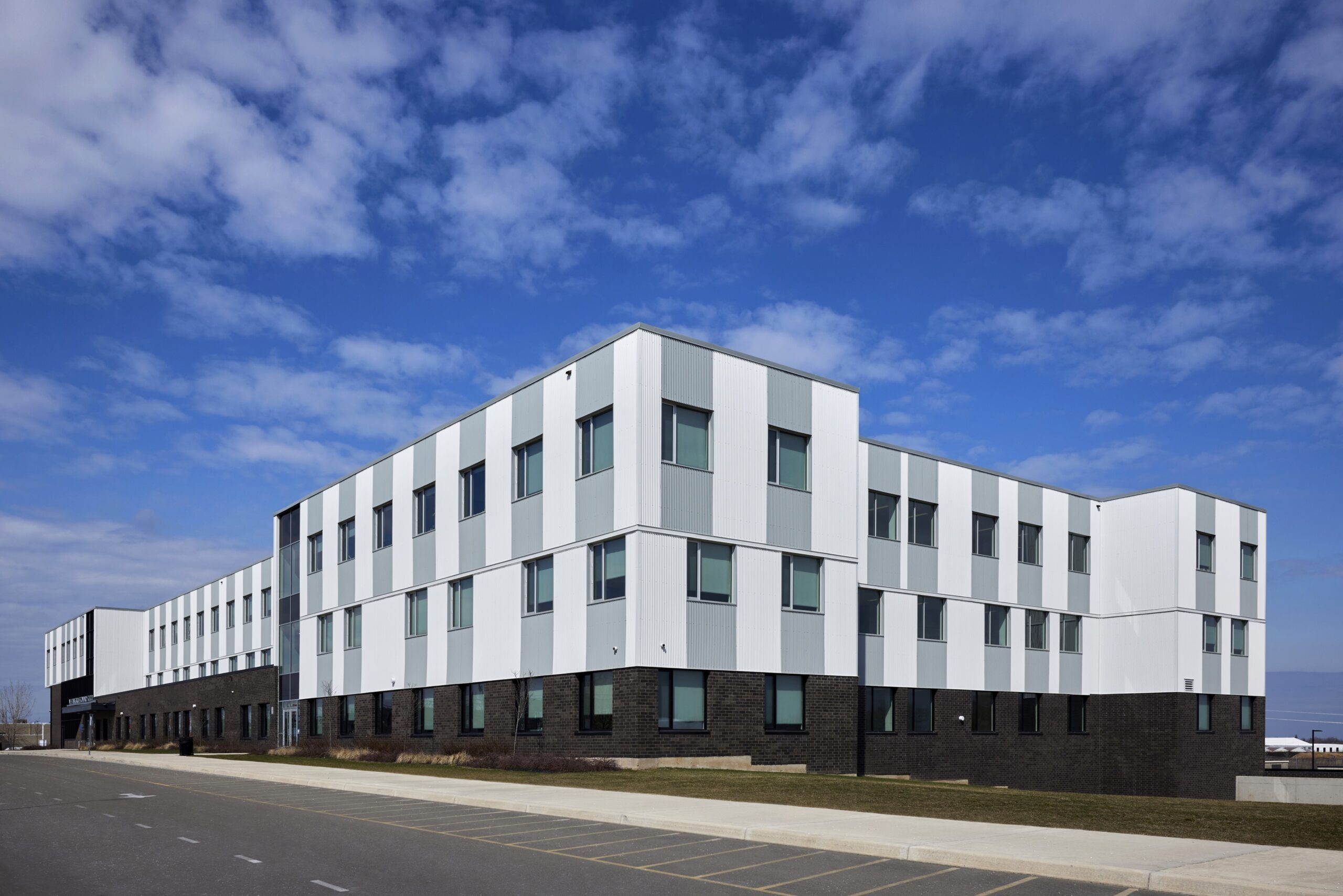
The first thing you notice about West Niagara Secondary School is the verticality of it. Or, rather, it’s what you should notice: the school itself is four-and-a-half storeys tall, but it’s so long and spread out that the height is de-emphasized. Upper floors of steel paneling sit atop a masonry foundation and first storey, seemingly cutting the building into two horizontal halves.
The reality is much more complicated and impressive.
“We built four storeys above grade, and half a storey below grade,” Spagnuolo explains. “We wanted to keep the footprint small, due to the site, and so we built up.”
Building up means playing with vertical space, something both Spagnuolo and Pastor delighted in. While WNSS’s exterior is fairly standard, the interior bends and overlays learning and social spaces into each other, creating incredible effects: the Learning Commons (supported by steel columns and beams) hovers above and “inside” the tall cafeteria space, atop a student-run cafe.
Also included? Two full-sized gyms (that can be converted into four), a whole slate of tech and auto workshops, and a 750-seat, acoustically-optimized theatre. Steel beams were essential to bring these spaces — spaces with wide spans and open air — to life.
Space to Grow
When it came to designing the school, the team at CS&P elected to separate the classrooms from the specialty spaces. “The building is really two major rectilinear forms: the gym/theatre/shop block and the classroom block,” Pastor explains. Where these forms meet is a large and intricate expansion joint that gives the expansive building flexibility, allowing it to shift and move both above grade and below. The joint utilizes slotted steel connections to maintain strength while allowing the different parts to move independently.
Rather than hide the expansion joint, Pastor and Spagnuolo opted to make it a feature of the school. Running along that expansion joint is the “spine”, a central hallway that serves as a connective route between the two blocks. The spine offers passersby a look down into the “taller” areas of the school: the gyms, and the tech shops. These areas — often exiled to the outer reaches of other schools — get a central focus at WNSS.
It was a decision that was made by experience, Spagnuolo says. “When I was in high school, the tech wing was where all the motorheads hung out, so I stayed out of that wing,” he remembers. “But one year, I had to take drafting, and that was in the tech wing. And that ended up being where I learned I wanted to be an architect. But if I was never forced to go into the tech wing, I would never have made that discovery.”
Opening these areas, then, offers students opportunities to discover new passions and interests. Was there a worry that having windows into the classrooms could be disruptive? “I haven’t heard of any issues so far,” smiles Spagnuolo.
Breaking Down Rigidity with Steel
Back outside the school, the facade is more intentional than it may initially appear. Take a closer look, and you’ll notice some key details that make the design sparkle.
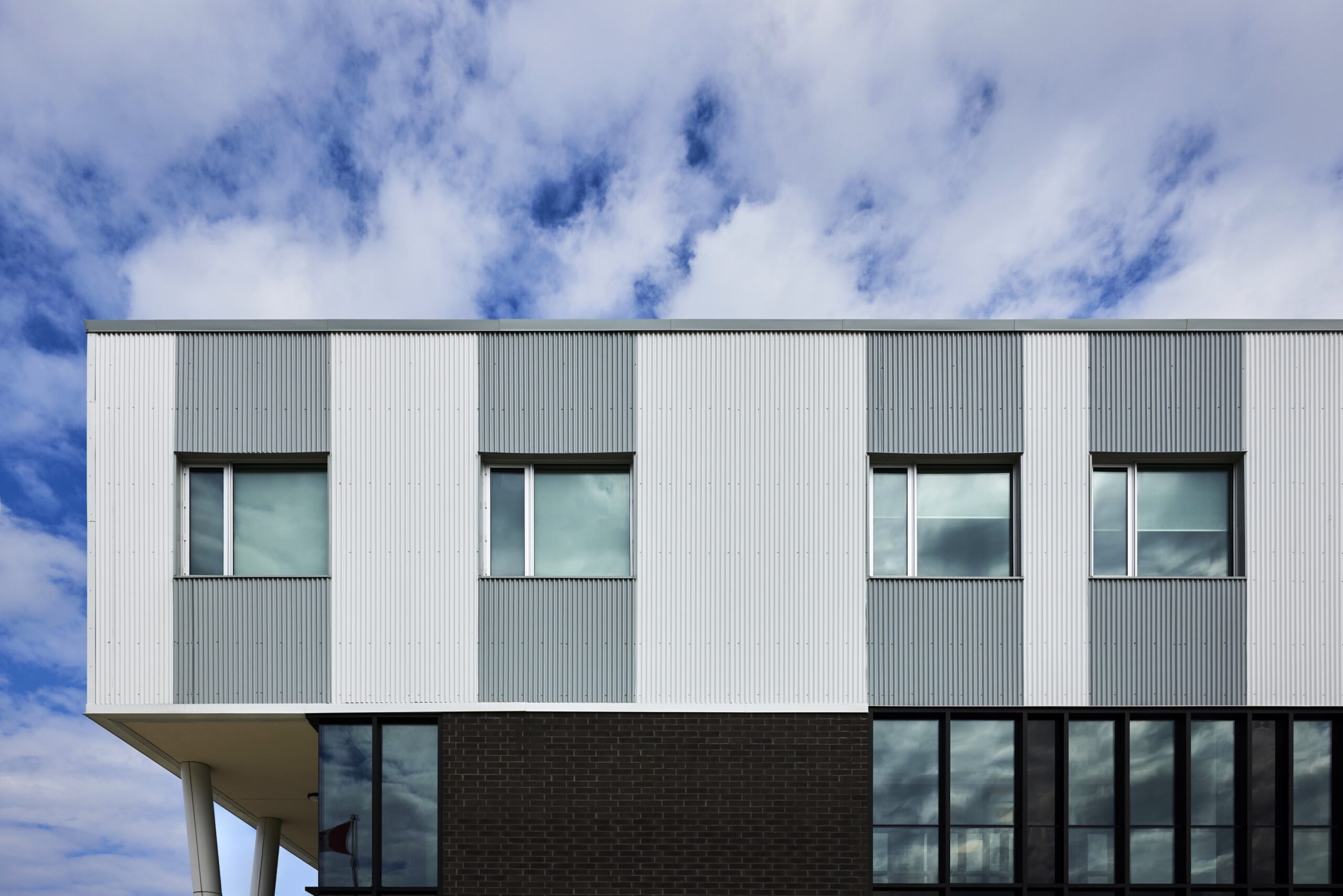
“We staggered the windows on the upper floor so it wouldn’t look so blocky,” Pastor points out. “The idea of that look is to break down the heaviness, or the rigidity, of a ‘traditional’ school.”
Steel paneling was also used to break up that rigidity. The architect team used a corrugated panel in varying widths and colours to add visual interest to the facade.
“We’ve used these panels often in other projects,” Pastor says. “They give a level of visual interest, detail, flexibility, and ease-of-construction. All of those qualities are important on a project like this.”
Even though the panels have many advantages, Pastor points out that there are ideal conditions for them. “We chose to have a masonry main level,” he says. “Basically, anywhere the students can reach is masonry.” We can’t disagree with keeping the pristine steel panels away from teenagers.
But steel panels had to be included for another reason. “Steelmaking is very important, historically, to the area,” Pastor says. “The school is close to Hamilton, and there are lots of fabricators working here today.” In fact, the steel that now clads the school was originally made by Hamilton’s ArcelorMittal Dofasco, before those raw coils were fabricated into the steel panels by Agway Metals.
Using steel, then, was symbolic in addition to practical. “West Niagara Secondary School acknowledges this tradition and carries it forward into the future,” he says.
SPECIFICATIONS
PROJECT COMMISSIONER:
District of Niagara School Board
DESIGN:
CS&P Architects
PRODUCT:
Agway Metals Inc.
PRODUCT:
Agway 22mm corrugated metal face panels, Agway HF12, 300mm wide face panels
STEEL:
ArcelorMittal Dofasco